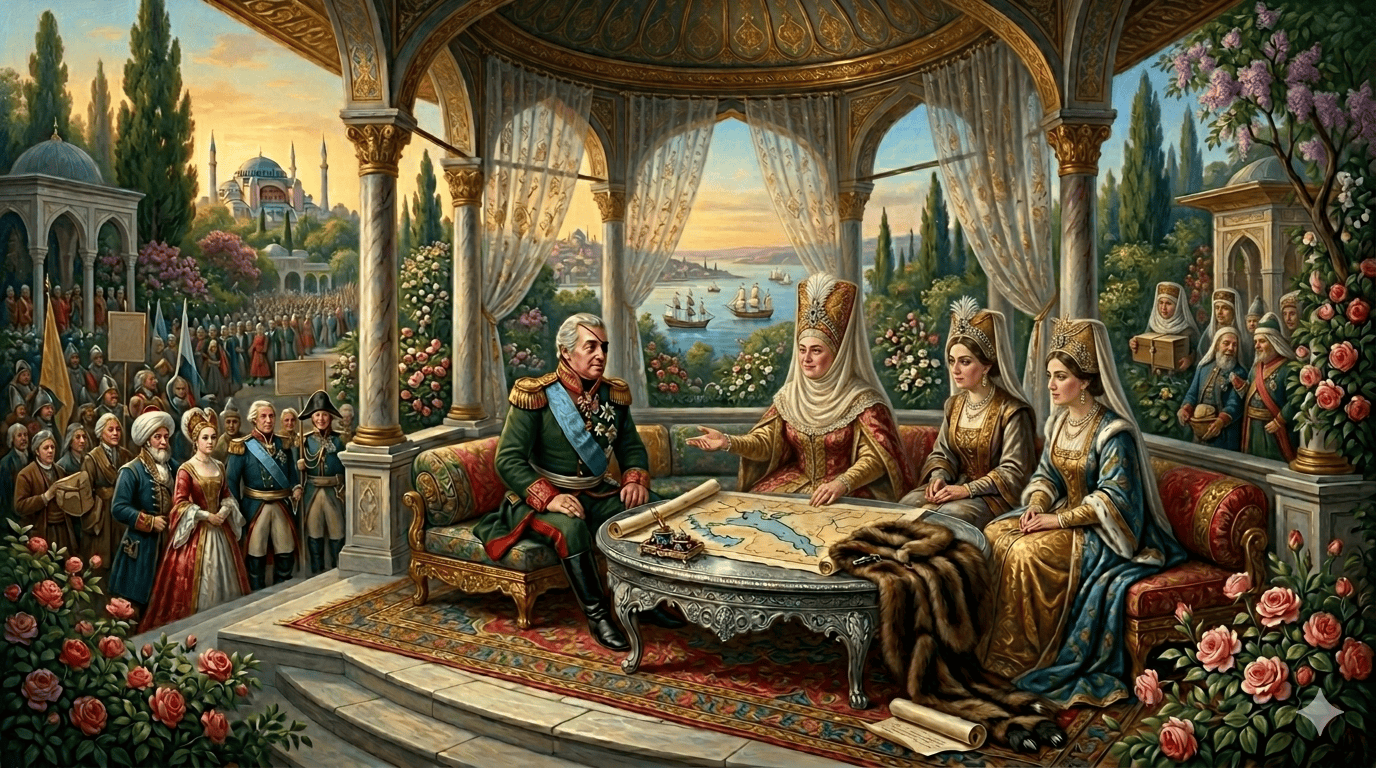
Kutuzov in the Harem
Catherine II — “Padishah of the Russians”, a title the Porte conceded in Article Thirteen at Küçük Kaynarca — wanted Constantinople. The stated purpose was, naturally, the relief of oppressed Christians. She spent freely on Alexei Orlov‘s efforts to set Greece alight, and after Çeşme Orlov proposed taking the city there and then. It was too early. Sophie Friederike Auguste of Anhalt-Zerbst was ambitious, but she was also careful, and without the second quality she would never have acquired the throne on which to exercise the first.
So in 1793 she sent her favourite instead: the equally careful and considerably cannier Kutuz Pasha, as the Ottomans called him — Mikhail Illarionovich Golenishchev-Kutuzov — at the head of a spectacular piece of espionage disguised as an embassy. His hosts needed no dictionary for the name: Kutuzov derives from the nickname Kutuz, and that from Turkic qutuz, “rabid, frenzied”. Which is to say that the Porte’s negotiations were conducted by a man whose surname advertised precisely the temperament he did not possess.
Consider the scale. Four hundred people on the official roll, plus households, plus assorted persons who attached themselves along the way: six hundred and fifty souls in all, proceeding towards Constantinople at a stately crawl, ostensibly on account of the general’s old wounds and in fact so that the general could establish the economic condition and military strength of the Ottoman Empire at leisure. Six months of leisure, as it turned out. Kutuzov used them, analysing what came in, forwarding it to Suvorov and Mordvinov on the Black Sea command, and learning Turkish from a Crimean official he had brought along for the purpose.
The gifts were magnificent and the budget was not modest: three million roubles for the mission and its presents, something over a billion and a half in today’s money. Jewels, collectors’ weapons and furs went to the Sultan, the Grand Vizier and every dignitary in between. Kutuzov tipped in ermine. Guests of such generosity were received with corresponding hospitality, and the embassy was given what can only be described as the VIP tour.
Kutuzov and his suite saw the Blue Mosque, the Bayezid Mosque and, above all, Hagia Sophia. Where other foreigners were admitted to the galleries between prayers and no further, the Sultan issued Kutuzov a firman — the word is in English dictionaries, and comes through Turkish from Persian فرمان farmān, “command” — permitting the distinguished guest, his suite and an honour guard the full tour. Curiosity ran so high that the Prussian minister’s wife joined the party in men’s clothing. On the way out, the visitors were met by traders offering fragments of smalt fallen from the mosaics — another word that made the same journey, from Italian smalto, and which English shares with enamel and smelt.
Kutuzov also, it is said, achieved the impossible and got into the harem.
This comes from a certain class of Russian publication — the kind that specialises in declassified sensations — and from Turkish outlets citing those same Russian publications and nothing else. What the story actually describes turns out not to concern the harem at all. But sensationalism laid over ignorance will make a mountain of a molehill and then plant a flag on the summit.
Begin with the word. Harem comes from Arabic حرام ḥarām, “forbidden, set apart”, the same root as haram and ihram. Forbidden is not the same as secret: it denotes the part of a house closed to unrelated men, not the chamber of odalisques the European imagination supplies. Half the sensation dies on the etymology.
What is alleged is this: that Kutuzov
bribed his way into the harem garden and there met three former Christians — the daughter of a Georgian priest who had become the wife of Sultan Mustafa III, that woman’s daughter, and a Frenchwoman who had become a concubine of Abdul Hamid I.
The reigning sultan at the time was Selim III. Taking the rest in order:
The harem garden. Nobody, I suspect, let Kutuzov into the harem, and he had no need of it. A meeting could perfectly well have been arranged in the Gülhane gardens — the name means “house of roses” — which had pavilions enough for the purpose. The park was closed to the public, certainly. It was not part of the harem.
The daughter of a Georgian priest is Mihrişah Sultan, the valide sultan — from Arabic والدة wālida, “she who bears” — and mother of Selim III, at this point about fifty. She was rather more than a dowager: her personal revenues and influence made her something close to a shadow prime minister, deciding how the very large sums at her disposal were spent and who did or did not obtain a private audience with her son. Meeting her was not an attempt on the secrets of the harem. It was a negotiation at the highest level available.
Her daughter was nothing of the kind. Hatice Sultan, variously described as Mihrişah’s daughter or Selim III’s, was in fact the daughter of Mustafa III by Adilşah Kadın, which made her Selim’s half-sister. She was twenty-five. Since 1786 she had been married to Seyyid Ahmed Pasha, warden of Khotyn, her senior by a good fifty years; a son had arrived in 1788 or 1789; she would be widowed in 1798. She was close to Mihrişah and to her brother, patronised architecture, and pressed the case for European ideas at court.
The Frenchwoman was Nakşidil Sultan, consort of Abdul Hamid I and mother of the future Mahmud II, born in 1785. Her own birth is placed anywhere between 1761 and 1766, and her origins are disputed: the Turkish historian İbrahim Pazan argues for Georgian, others say more cautiously “from the Caucasus”, occasionally “Circassian”. On Abdul Hamid’s death in 1789 the late sultan’s consorts were removed to the Old Palace at Bayezid, where Nakşidil remained until her son’s accession in 1808, while Mahmud stayed in the harem at Topkapı. Her presence at any such meeting would have required the gates of the Old Palace to be opened specially — which is a better story than the one on offer.
As for the Frenchwoman: the legend identifying Nakşidil with Aimée du Buc de Rivéry, a kinswoman of Joséphine de Beauharnais lost at sea, surfaced in European print after Nakşidil’s death in 1817. Its pedigree is long. Claims of kinship between the French and Ottoman houses had been manufactured as a diplomatic instrument since the sixteenth century, when Selaniki recorded that the King of France was “our prince, and of our blood”; fifty years after Nakşidil, Sultan Abdülaziz would assure the world that his grandmother and Napoleon III’s were related. An invented tradition of the purest kind, taken out of the cupboard whenever the alliance required dusting.
So what is left? Three women: the reigning valide sultan, the most powerful woman in the empire; a married princess of pronounced European sympathies, sister and confidante of the Sultan; and the widow of a dead sultan, for whom the Old Palace gates were opened. They meet the ambassador of the power that has just defeated them, to discuss matters that cannot yet be entrusted to the Divan. One struggles to see the scandal. It cannot have been a daily occurrence, but then the circumstances were not daily either, and both parties genuinely wanted an understanding. Kutuzov was, undeniably, a man — but an elderly one, of an age with Mihrişah, and he represented an empress.
There was, I am afraid, no sensation in that meeting whatever. The voyage did, however, advance the causes of tourism and espionage in roughly equal measure.


