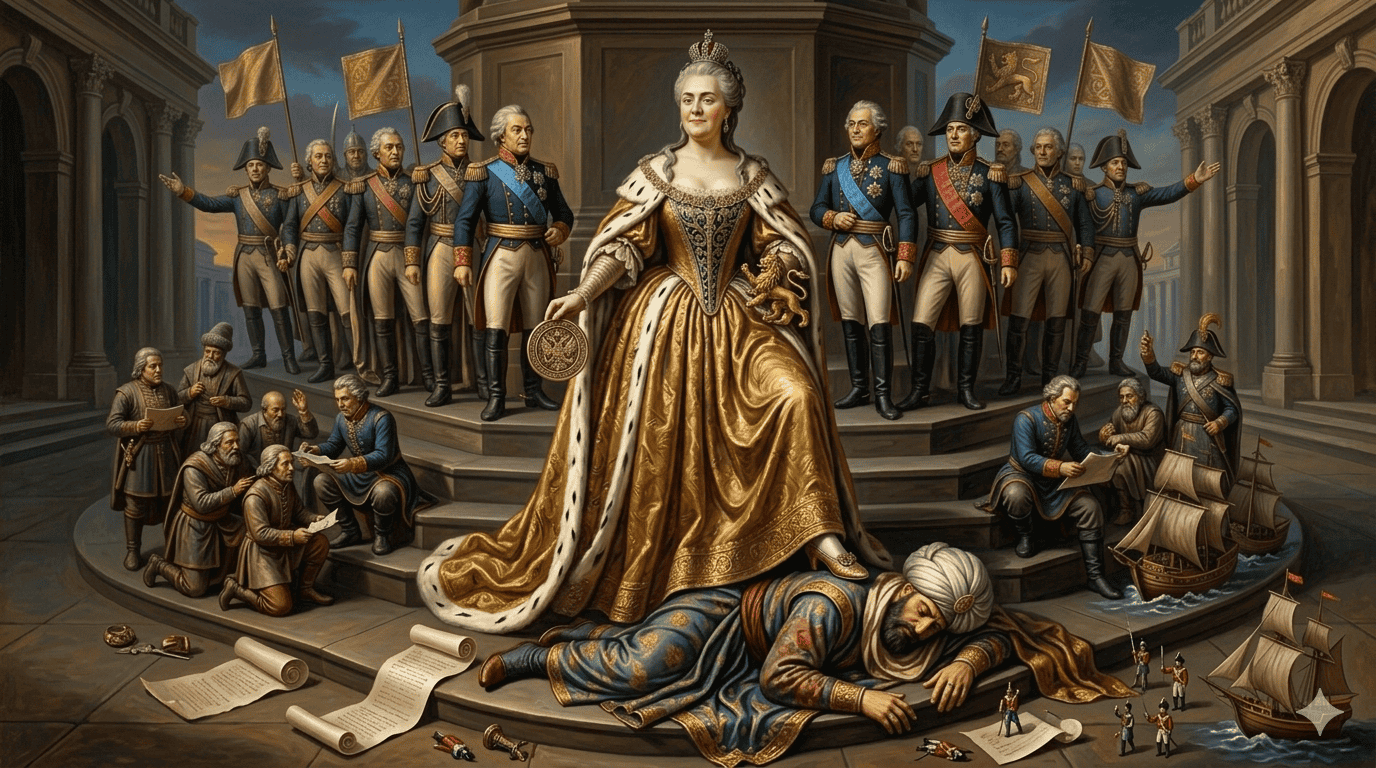
The Empress, the Sultan, and the Fatal Dispatch
If the first quarrel between Muscovy and the Ottoman Empire was set off by the hooliganism of a Crimean khan, everything that followed turned on the Astrakhan Khanate. Ivan the Terrible took it in 1556; Suleiman the Magnificent had other ideas, involving the recovery of Astrakhan and a canal joining the Volga to the Don. He did not live to attempt it. The expedition sailed in 1569 under his son Selim II, and would have done better to stay at home: the Russians lifted the siege, scattered the canal-diggers, and a storm on the way back finished off what remained of the fleet.
In 1571 Devlet Giray burned Moscow. (In the same year, at the other end of Europe, the Holy League destroyed the entire Ottoman Mediterranean fleet at Lepanto — some two hundred and thirty galleys, the largest oared battle in history — after which the Ottomans built another one inside a year and took Tunis. Among the wounded was the future author of Don Quixote, who left his left hand there and his reputation for understatement intact.) The following summer, in the thick of the Livonian War, a Russian army broke the combined Crimean, Ottoman and Nogai force at Molodi, forty miles south of Moscow, and made the middle and lower Volga Russian for good.
The Quiet Century That Wasn’t
The next hundred years were calmer, though not as calm as the textbooks suggest. Russia collapsed into the Time of Troubles; the Ottomans fell under the Sultanate of Women and turned their attention to Asia and Africa, where they dreamed of a Suez canal and failed to build that one too. Even so, between 1676 and 1681 the two powers fought in earnest over the right bank of the Dnieper: an Ottoman army besieged Chyhyryn twice, took it on the second attempt, and discovered there was nothing left worth taking. Only then does the regent Sophia, elder half-sister of Peter the Great, decide to join the European coalition and settle the Crimean question once and for all.
She did not settle it. The army of her favourite, Prince Golitsyn, failed to reach the Crimea twice, the hetman’s Cossacks marching alongside being no help whatever. Peter, having deposed his sister, preferred his own methods and took Azov. Then Charles XII lost Poltava, fled into Ottoman territory, and Peter demanded his extradition. The Sultan declared war instead. Peter marched into Moldavia, lost, and gave Azov back.
Other People’s Names
A quarter of a century later the war resumed. Münnich took Perekop, Bakhchisarai, Ochakov, Khotyn and Iaşi; the Don flotilla recovered Azov. Every one of those names belongs to somebody else. Perekop is a straight loan-translation of the Crimean Tatar Or Qapı, “ditch-gate”. Ochakov is the Ottoman Özi Kale, “the fortress on the Özi” — Özi being what the Ottomans called the Dnieper. There was, admittedly, little leisure for philology: the Treaty of Belgrade required the Azov fortifications to be levelled, forbade Russia a Black Sea fleet, and obliged her to conduct her seaborne trade in Turkish bottoms.

The Axe That Woke an Empire
In 1768 Ukraine erupted in the Koliivshchyna, a “holy war” waged by Cossack irregulars known as haidamaks. In Uman alone somewhere between a few thousand and twenty thousand civilians were butchered — Poles, Jews, Uniates, and Orthodox suspected of insufficient hostility to the infidel. (Nineteenth-century romantic nationalism found the episode stirring; Taras Shevchenko, Ukraine’s national poet, gave the killers a narrative poem of their own.) That June the haidamaks sacked the frontier town of Balta, which stood on the Ottoman side of the line, and the joint Polish-Russian counter-terrorism operation caught up with them shortly afterwards. Sultan Mustafa III declared war on the Russian Empire, which was the gravest mistake of his life.
There is a joke buried in the vocabulary. Haidamak comes from Turkish haydamak, “to drive off, to rustle”, the same root as haydut, “bandit”, which reached English by a different road as heyduck and gave Hungarian its hajdú. The men who sacked an Ottoman town for the glory of Orthodoxy were calling themselves by an Ottoman word. So, for that matter, was the town: balta is Turkish for “axe”.
Padishah of the Russians
Catherine — matushka, the little mother, as a German usurper on the Russian throne found it prudent to be called — made the most of the opening. One Golitsyn drove the Turks back to the Danube, Dolgorukov occupied the Crimea, and Alexei Orlov burned the Ottoman fleet at Çeşme — a bay whose name is simply Turkish çeşme, “spring, fountain”, from Persian چشمه, itself from چشم, “eye”. The eye of the earth, and by 1770 an unusually bright one.

The peace that Rumyantsev signed at Küçük Kaynarca gave Russia Kerch and Yeni-Kale, Azov, and the steppe between the Southern Bug and the Dnieper; it opened the Black Sea and the Straits to Russian merchant shipping, and the Holy Land to Russian pilgrims. The Crimean Khanate was declared independent of both powers, retaining only its spiritual tie to the Caliph — a legal arrangement which nine years later allowed St Petersburg to swallow the peninsula whole. And in Article Thirteen the Porte undertook to address the Russian sovereign in official correspondence as Rusyaların padişahı, “Padishah of the Russians”. The title was not earned but extracted, and extracted from the one man entitled to grant it.
Four Months
Fifteen years on, the Ottomans — outraged by the final annexation of the Crimea — declared war again, with the same result. Suvorov won at Râmnic and stormed Izmail, the allied Austrians took Belgrade, and in the Caucasus Anapa fell to assault. Both Belgrade and Anapa were handed back at the peace; Anapa would not become Russian until 1829. The Treaty of Jassy moved the European frontier to the Dniester.

As for Ochakov: when the news of Potemkin‘s storming of it reached the palace, Sultan Abdul Hamid I suffered a stroke and died. So, at any rate, runs the Ottoman tradition, which Cevdet Pasha reports along with the fall of Khotyn and Hacıbey. Four months separate the December dispatch from the April death, and no physician would care to certify the connection. Historiography has certified it anyway.
While Napoleon was rearranging Europe, the Porte decided to put its Danubian vassals in order. Kutuzov‘s operation at Slobozia in the autumn of 1811 obliged the Empire to sign the Treaty of Bucharest and surrender Bessarabia. The treaty was concluded on 28 May 1812, rather over a month before Napoleon crossed the Niemen.
A further century and four more Russo-Turkish wars lay ahead.


