The Poet Was Not Impressed
Back to Erzurum, then, as Pushkin saw it. Or rather, as he failed to.
Begin with the name. He calls the place Arzrum, which is not poetic licence but a form closer to the original than the one we use today. Behind it stands Arz-ı Rum, “the land of the Romans” — an Arabic noun in a Persian construction, inherited by the Turks along with the territory itself, taken from Byzantium. Pushkin wrote what he heard from the people who lived there, and heard it more accurately than the tradition that followed him.
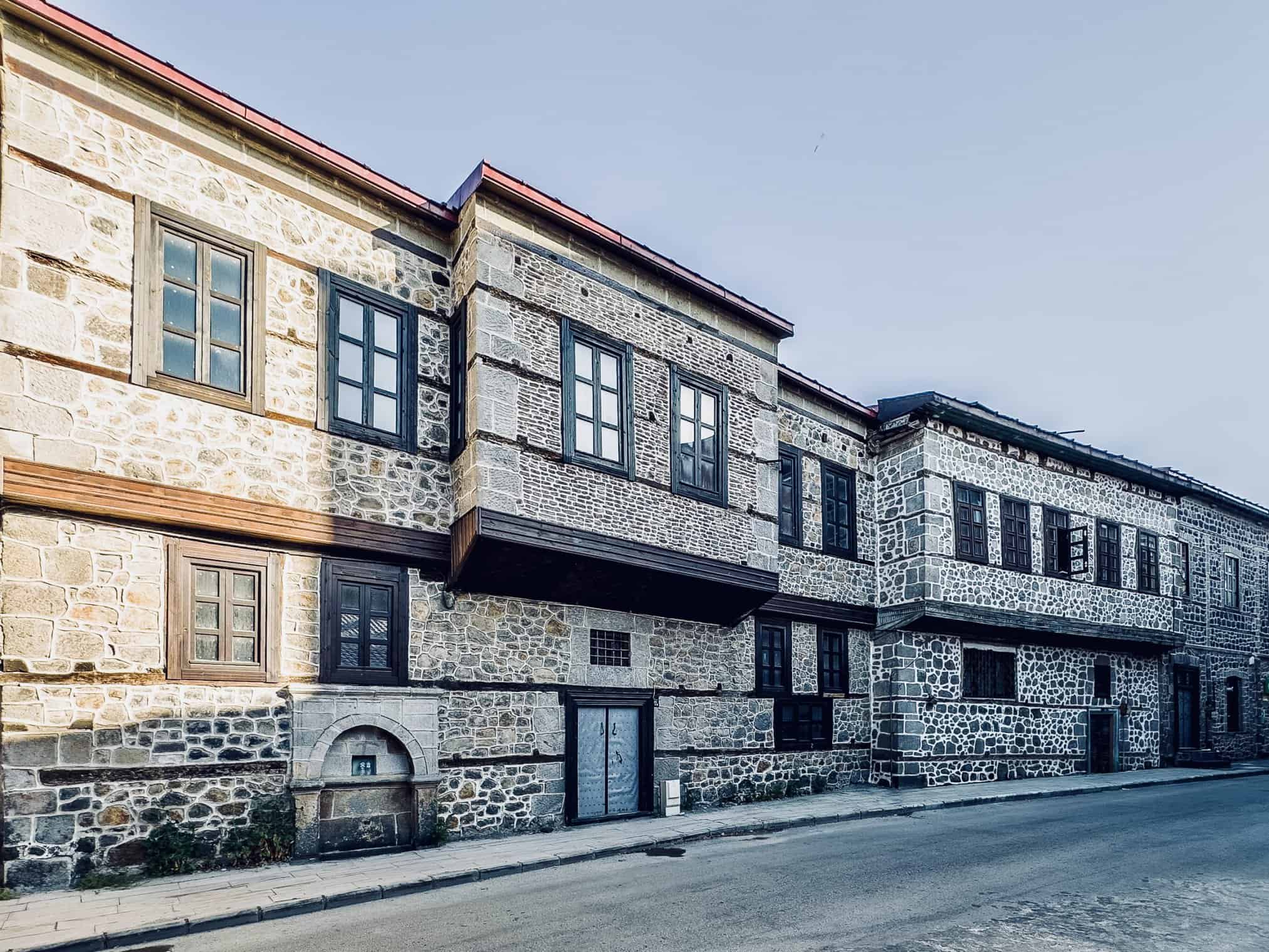
Rayevsky rode into the town and I went with him. We entered a city that presented an extraordinary picture. Turks looked down at us gloomily from their flat roofs. Armenians crowded noisily in the narrow streets. Their boys ran ahead of our horses, crossing themselves and repeating: “Christian! Christian!” […] The streets of the town are narrow and crooked. The houses are fairly tall. […] The houses are of stone, the roofs covered with turf, which gives the town an exceedingly strange appearance when seen from above.
Narrow and crooked they remain. This is one of the lanes of the old town, along which Pushkin in all probability walked: the Western consulates stood here, the Russian — later Soviet — among them.


Next comes the water, and it is the one thing in Erzurum that meets with his approval.
Arzrum is famous for its water. The Euphrates flows three versts from the town. But there are fountains everywhere. A tin dipper hangs on a chain at each of them, and good Muslims drink and cannot praise them enough.
There are indeed fountains everywhere. The one photographed here stands between the Yakutiye madrasa and the Lala Pasha mosque — which is to say precisely between two buildings about which the poet found nothing whatever to say.

And here the interesting part begins.
The mosques are low and dark. Outside the town there is a cemetery. The monuments consist for the most part of pillars decorated with a stone turban. The tombs of two or three pashas are of somewhat greater elaboration, but there is nothing elegant in them: nothing of taste, nothing of thought… One traveller writes that of all the cities of Asia he found a clock tower in Arzrum alone, and that it was broken.
Almost every clause here has a photograph waiting for it.
“The mosques are low and dark.” Ulu Cami is low and dark, admittedly, and means to be: 1179, seven naves, Seljuk austerity, the light admitted sparingly and exactly where it is wanted. Beside it stands Lala Pasha, Ottoman classicism from the workshop of Sinan or very near it, with a dome that only a man determined to look at nothing could call low.g.


“The tombs of two or three pashas.” These are almost certainly the Üç Kümbetler, and there is not a pasha among them. Under the conical roofs, a few steps from the Twin Minarets, lie the Saltukid emirs, masters of the city six and a half centuries before Pushkin’s visit. The carving on the walls — eagles, serpents, bulls — is the work he declined to credit with thought.

“Nothing of taste, nothing of thought.” One would like to argue. First, though, one ought to make the case for the defence.
Pushkin did not come to Erzurum to look at it. He came to fight, and was not permitted to. He spent a few weeks here in June and July, in the middle of an outbreak of plague, attached to an army that had just taken a city and had no clear idea what to do with it. He walked not through monuments but through somebody else’s town, where people watched him gloomily from the flat roofs — his own observation, not mine. And he judged as an educated European of 1829 judged: whatever was neither classical nor Renaissance was Asiatic bad taste by definition. Kinglake would produce four hundred pages in the same key fifteen years later and be applauded for them. In that sense “nothing of taste” is not a verdict on Erzurum. It is an unusually exact self-portrait of a generation.
“And that it was broken.” The clock, as it happens, is still there. It stands on the tower in the citadel, and in front of it fly the flags of the Economic Cooperation Organization, which has named Erzurum its cultural capital for the year.

A city in which one passing traveller could find neither taste nor thought has taken rather less than two centuries to be rehabilitated. The clock, one assumes, has been seen to.


