From Pastoral to Gladiator

Today, ladies and gentlemen, we have men and beasts—and one is seldom perfectly sure which is which.
Faced with these nine mosaics, the modern eye cannot help sorting them into the “charming” (putti among the vines, birds beneath a tree) and the “appalling” (a severed head upon the sand). The villa’s owner, however, drew no such line. This is not a case for the psychiatrist’s couch; it is simply life.
In our Museon, we hold to the ancient view of things:
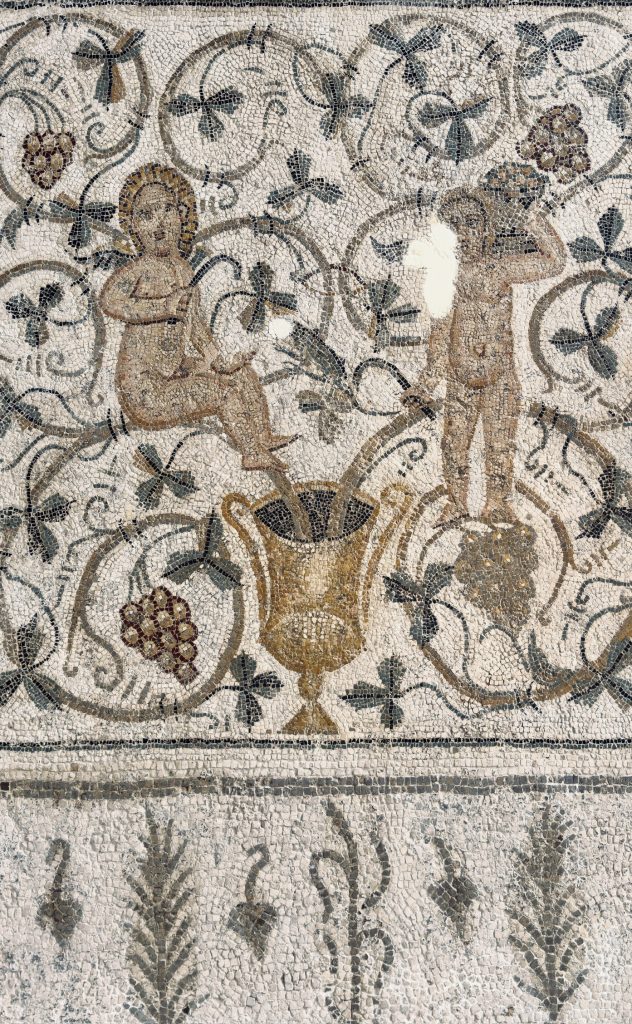
- The World as Resource: A horseman coursing hares with his hounds, a huntsman drawing his bow—these are not “cruelty” but the natural order, quite as much as the putti gathering grapes in their graceful frieze. The harvest of the earth and the harvest of the chase are, after all, one and the same undertaking.
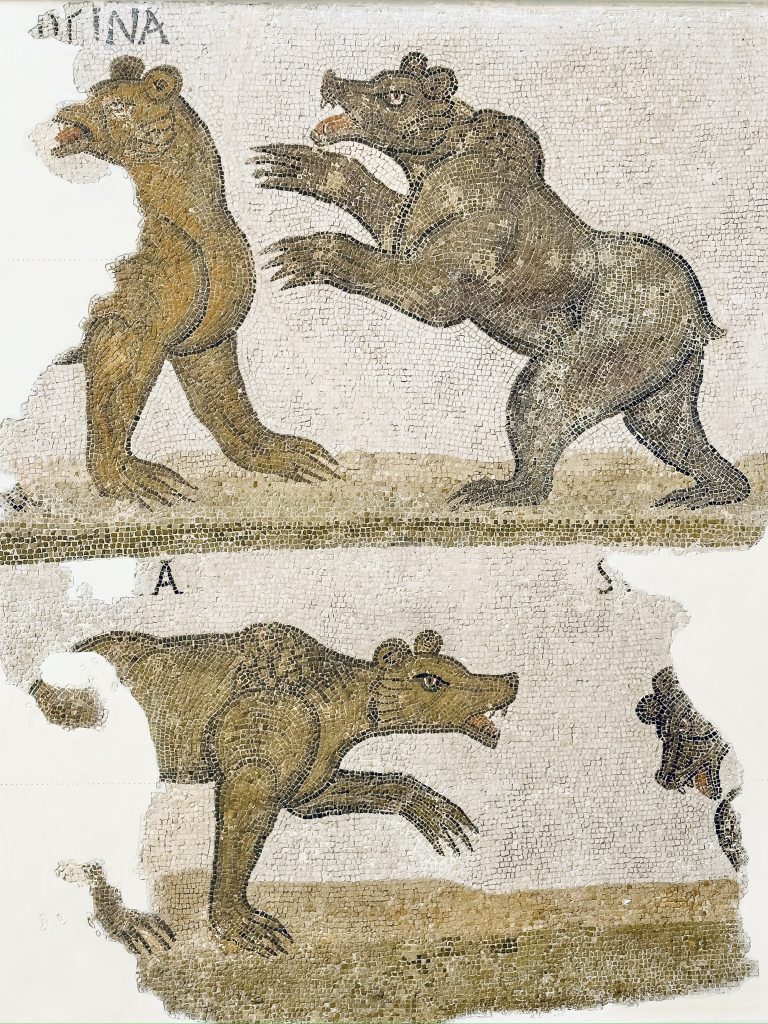
- Venationes as the Triumph of Order: The baiting of beasts—bears, bulls, boars—and the gladiator running a lion through with his spear to applause from the boxes: all of this proclaims that man has mastered the chaos of the wild. Even the curious youth with a halo, standing serene amid a ring of maddened predators and a serpent at his feet, is a figure of mastery, not of madness.
- The Kill as the Final Scene: A scene of one man taking another’s head sits quite naturally beside a tiger skin and a pastoral doe. In the age of the Twelve Caesars, death in combat was as much a feature of interior decoration as a vine tendril. This is not a matter for a content warning; it is the reality in which people lived, dined, and slept.
These mosaics adorned the floors of living rooms not to frighten, but to mirror the fullness of existence. From the quiet hunt in the forest to the last breath drawn upon the sand of the arena, for the Roman all of it belonged to one and the same natural order.
You blocks, you stones, you worse than senseless things!
Here, the line serves not as an accusation, but as a plain statement of fact. In this world a beast might be humane, and a man a beast, and either case was received as the natural order—worthy, indeed, of being set down forever in stone.