
Between Myth and Form
Today, dear reader, we turn our attention to sculpture. You know how passionately I adore it. As the cover for this post, I have chosen the Eastern Calendar fountain near the Kazakhstan Academy of Sciences (artist V. Tverdokhlebov, architect V. Katsev, sculptor A. Tatarinov, 1979). The little creatures in the Kazakh zodiac look, to put it mildly, somewhat eccentric, yet they command attention with undeniable theatricality.
By the way, the local zodiac is remarkable for more than just its aesthetic whims. While all twelve-year cycles across Central and Eastern Asia feature a dragon, the Kazakh version replaces it with a snail. One might surmise that ancient steppe dwellers had precious few encounters with dragons, and thus, instead of the Chinese lóng, Turkic and Mongolian nomads reinterpreted the sound as something rather more familiar—namely, snails, yielding words like luu or lyu. Consequently, this year of the Eastern calendar is known in Kazakh as ұлу. And while earnest scholars persist in arguing that a dragon was intended all along, the Almaty fountain leaves us in no doubt: it is a snail, proudly triumphant.
However, that was merely a modest overture. Let us transport ourselves to the A. Kasteyev State Museum of Arts to trace how sculptors’ perspectives on humanity, labour, and history have shifted—from Stalinist Empire style to contemporary introspection.
An Age of Ideals: Man and Creation
Upon entering the exhibition, the visitor is greeted by Pyotr Usachyov’s (1930–1976) Harvest (1962). In a manner characteristic of the Stalinist idiom, the sculptor captured the paramount obsession of the era—the cultivation of the Virgin Lands. Observe how the composition echoes Piotr Wójtowicz’s allegory of Glory adorning the Lviv Opera House: the exact same gesture, the exact same solemnity, elevating agricultural toil to the rank of an ancient heroic feat.


Another piece dedicated to the working man is Alexander Isayev’s (1929–1987) Steelmaker (1958). The hero’s posture unmistakably betrays its source of inspiration—Ivan Shadr’s celebrated Cobblestone – the Weapon of the Proletariat. This was an epoch when sculpture was expected not merely to depict, but to electrify and broadcast ideological pathos.


Freedom of Vision: Animalism and Hidden Meanings
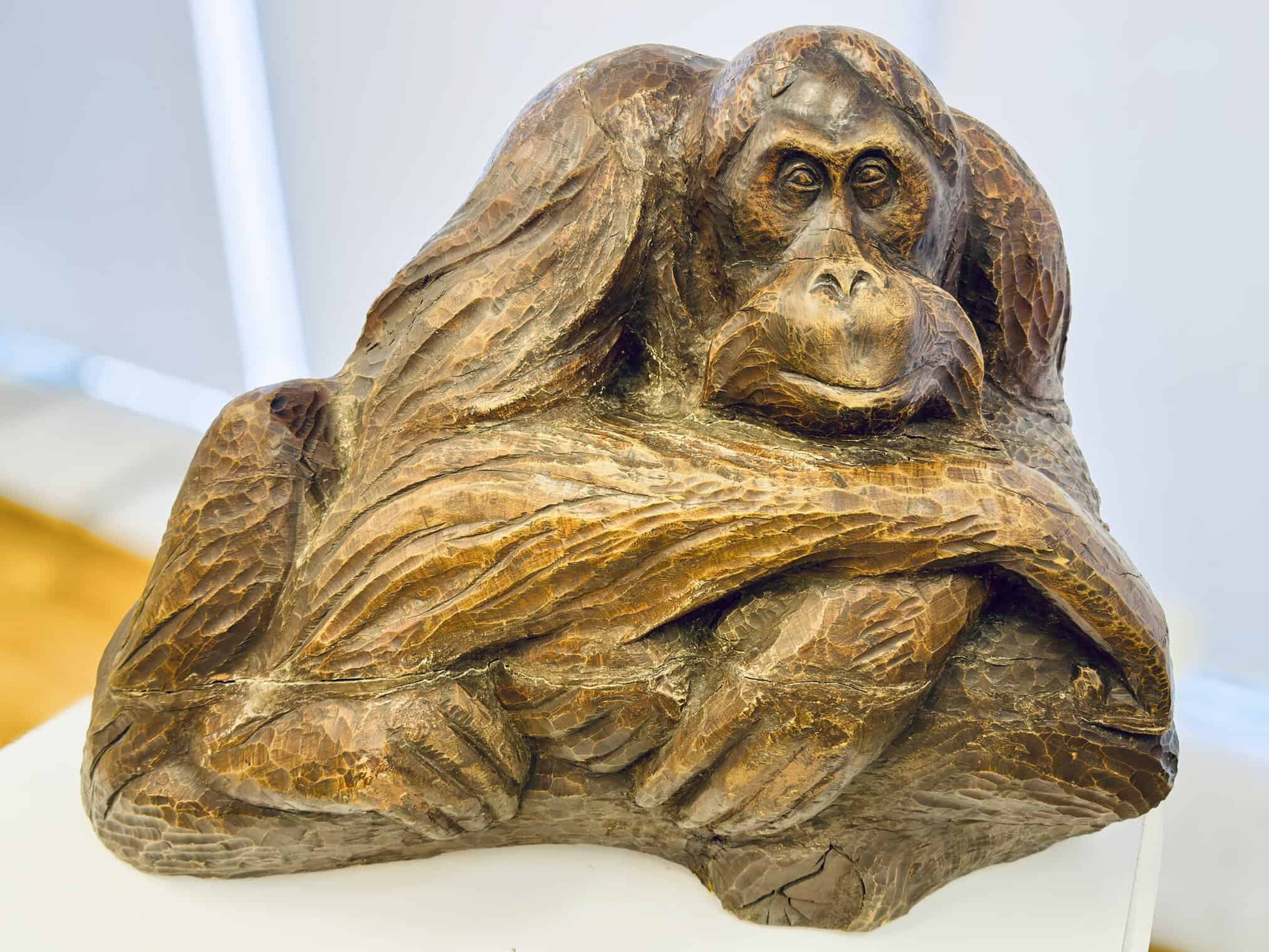
By way of contrast, let us examine a piece from the same Soviet period: Vasily Vatagin’s (1883–1969) Orangutan (1930). This renowned animalier dedicated his entire life to depicting the animal kingdom. Yet, for reasons best known to my own subconscious, this orangutan evokes faint echoes of monumental propaganda… One is half-reminded of Lenin hiding in the haystacks at Razliv, or perhaps Marx in Revolution Square. All things considered, it is rather fortunate that Vatagin did not survive to our times; today’s professional thespians of outrage would manage to unearth subversion even within a primate.
A New Voice: Silence in Place of Grandeur
Let us now turn to more contemporary works, where the artistic focus shifts from the grand collective to the deeply personal.
Here we have Yesken Sergebayev’s (b. 1940) Victory (1995). Despite the heavy state-mandated pomp that accompanied the fiftieth anniversary of the end of the Second World War, the sculptor speaks to us of something entirely different—the fragility of memory and the quiet dignity of old age. Though his voice is hushed, the statement loses none of its resonance.

And I should like to conclude with Zhanna Nugerbek’s (b. 1988) Jaylaw (2016). The Kazakh word jaylaw—much like the Turkish yayla(k)—denotes high-altitude summer pastures (derived from the Turkic root yay, meaning ‘summer’; compare the analogous Kazakh qıstaw, Turkish kışlak, stemming from Turkıc qysh, from Proto-Turkic *kïĺ ‘winter’). To heighten the illusion of an endless, wandering herd, the sculptor has placed her creation upon a mirrored surface.

Contemplating these works, one cannot help but appreciate how the language of sculpture has transformed: from the grandiose, skyward-striving gesture into an intimate meditation on roots and space. If back in the 1960s sculpture functioned as a manifesto, today it has matured into a quiet meditation. Which appeals to you more: the triumphant theatre of classical forms, or the muted depth of contemporary meanings?


