
The Twenty-Two Letters That Changed the World
As promised, the particulars of the Phoenician alphabet. It had twenty-two letters. They wrote from right to left, so do read the Phoenician characters starting from the right-hand side.
From Ox to Window: The First Sounds
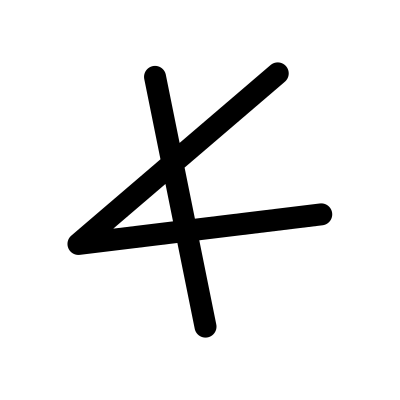
ʾālep ‘ox’
The squiggle before the “a” denotes a glottal stop—the catch in the throat you hear in the middle of Cockney bo’le (bottle), in the American uh-oh, or in the German Beamter. The letter depicts an ox’s head with horns, and became—as you will have guessed—the ancestor of Greek Αα “alpha” and of every Aa thereafter.

bēt ‘house’
It looked like the floor plan of a modest dwelling with a doorway. It turned into Greek Ββ “beta,” Latin Bb, and the Cyrillic Бб and Вв into the bargain.

gīml ‘spear’1
Greek Γγ “gamma” and Cyrillic Гг, naturally. With the Latin Gg, however, an amusing thing happened. In Etruscan, for which the Phoenician alphabet was first adapted, there was no /g/ sound at all; so giml, which had become C, was pressed into service for /k/ alongside K and Q (C stood before the front vowels E and I, K before the back vowels A and O, and Q before U—possibly marking different allophones of the phoneme /k/). By the time of Latin the /g/ sound had duly appeared, and a letter had to be improvised for it: they took C, added a little horizontal bar, and out came G.
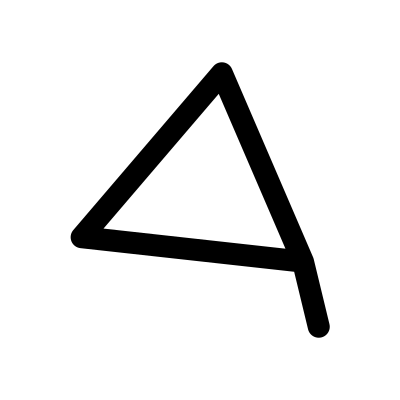
dālet ‘door’2
The unmistakable triangle of Δδ “delta” (were their doors triangular?) went on to become every manner of Dd and Дд.
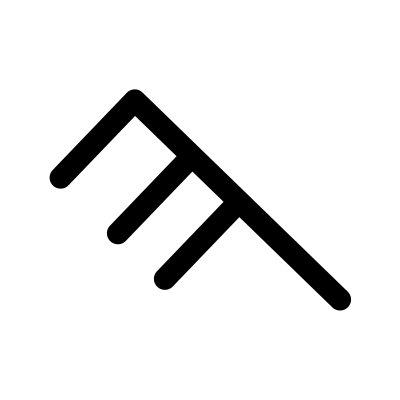
He ‘window’
The first sound is the fricative /ɣ/—the soft, throaty /h/ you hear in the middle of Spanish amigo, or in Modern Greek γάλα. This Phoenician letter became Εε “epsilon” and the many and various Ee.
Hooks, Fences, and Palms

wāw ‘hook’
Both consonants here are not the stopped /v/ as in German but the glide /w/ as in English or Arabic. From this little hook descend the Greek Ϝϝ “digamma” (later found surplus to requirements) and Υυ “upsilon,” along with a whole clutch of Latin letters: Ff, Vv, and its offspring Uu and Ww, plus Yy—and, of course, Cyrillic Уу.
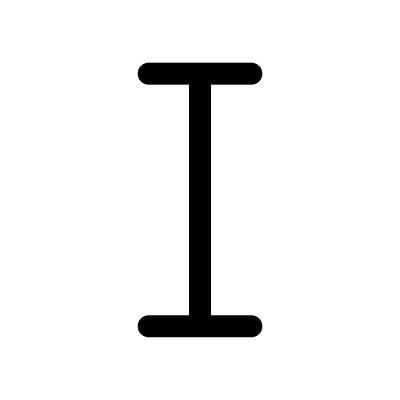
zayin ‘weapon’
Greek Ζζ “zeta” and Latin Zz are visible to the naked eye; Cyrillic Зз bears rather less resemblance, but comes from it all the same.

ḥēt ‘courtyard, fence, wattle’
This one gave us Greek Ηη “eta,” Latin Hh, and Cyrillic Ии.

ṭēt ‘wheel’
Spotting the Greek Θθ “theta” here is easy enough—as is the pre-1918 reform Cyrillic Ѳѳ “fita,” which stood wherever Latin wrote th (e.g. Theodore—pre-1918 Russian Ѳеодор—post-1918 Russian Фёдор).
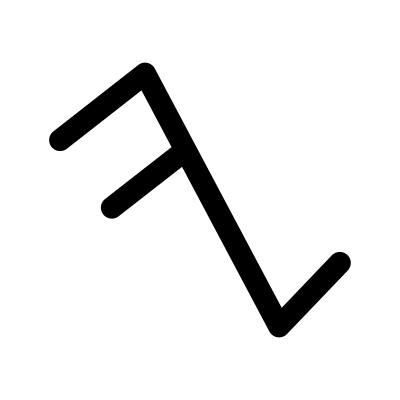
yod ‘forearm and upper arm’
Ιι “iota,” Ii, and Jj. It exists in Cyrillic too, and Russian once had it as well, under the name “decimal i,” since it denoted the tenth letter of the alphabet—while Ии was the “octal” one. Two distinct letters, pronounced identically in later centuries, at least allowed one to distinguish миръ “peace” from міръ “world.” (Leo Tolstoy, mind you, found this a positive nuisance—he had intended his novel’s title as a pun on both, so the orthographic reform of 1918 would surely have delighted him.)

kāp ‘palm of the hand’
Why the Phoenician palm has four fingers there is now nobody left to ask, but the characteristic shape of Κκ “kappa,” Kk, and Кк is unmistakable. In Greek it yielded not only “kappa” but Χχ “chi”—and hence Cyrillic Хх.
Elements and Symbols
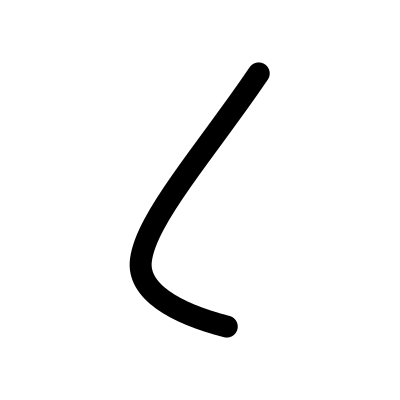
lāmed ‘ox-goad’
The recognisable line of Λλ “lambda”—Ll—Лл.

mēm ‘waters’
That characteristic wavy line is still traceable in Μμ “mu” and Mm—Мм.

nūn ‘eel, snake’
A little serpent indeed: Νν “nu”—Nn. Cyrillic Нн has strayed somewhat from the snake, though its horizontal bar was originally slanted, much as in the Latin letter.
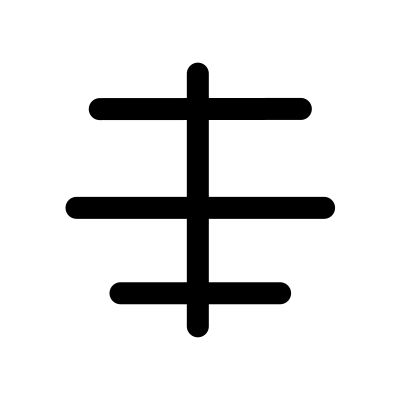
śāmek ‘pillar’
Here things grow trickier. The transformation into Greek Ξξ “xi” is transparent enough, but the onward journey to Latin Xx and to Cyrillic Ѯѯ “ksi”—discarded under Peter the Great—requires a certain amount of imagination.

ʿayin ‘eye’
The first sound of the name is rare among the world’s languages. It resembles the sound denoted by the very first letter of the Phoenician alphabet, save that the latter was voiceless and this one is voiced. If you have Arabic-speaking friends, ask them to pronounce اَﻟْﻌَﺮَبِيَّةُ /al-ʕarabiyya/ ‘the Arabic language.’ Speakers of certain North Caucasian languages—Avar, Chechen, Ingush—will oblige with any word containing the letter “гӀ” or “I.” Failing that, you may attempt it yourself by pushing the root of your tongue as far back into your throat as it will go.
To grasp what became of this Phoenician letter in our own alphabets, however, no such exertion is required. It became merely and forever Οο “omicron” and Ωω “omega” in Greek, and the perfectly ordinary Oo. In Cyrillic, its modifications also came to denote the short vowels Ъ and Ь, which in time dwindled away to nothing.
From Mouth to Mark

pē ‘mouth’
All perfectly transparent here: Greek Ππ “pi,” Latin Pp, and Cyrillic Пп.

ṣādē ‘papyrus (the plant)3
Greek and Latin found no use for this letter, but Cyrillic put it thoroughly through its paces—from it come both Цц and Чч.
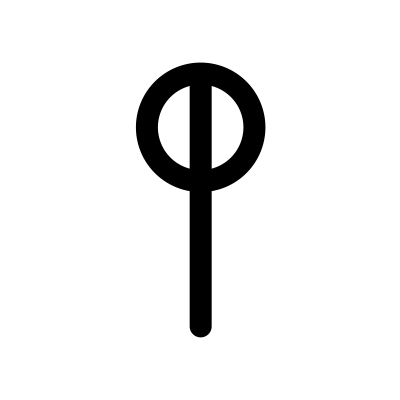
qōp ‘eye of a needle’
The first sound of the name is not a plain /k/ but one articulated with the back of the tongue—which is why Qq is still used in transcription for precisely that sound. Greek had a letter Ϙϙ “qoppa,” but it soon ceased to be wanted. As to whether the resemblance between Greek Φφ “phi,” Cyrillic Фф, and this Phoenician letter is mere coincidence, there is no settled answer.
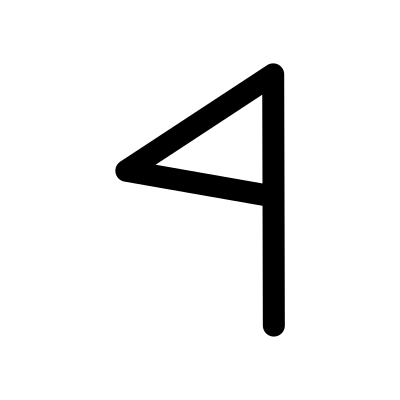
rēs/reš ‘head’
Complete with neck, evidently. Greek Ρρ “rho,” Latin Rr, and Cyrillic Рр.
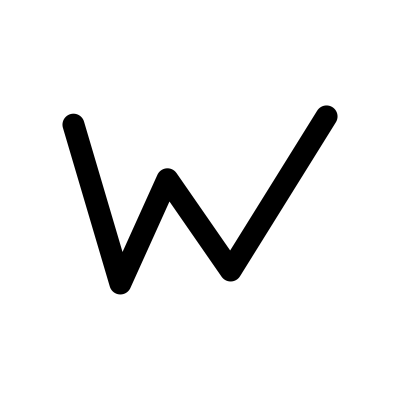
šīn ‘tooth’
Roots included, by the look of it. In Greek it produced Σσς “sigma,” in Latin Ss, and in Cyrillic Сс, Шш, and Щщ alike.

tāw ‘mark’
A simple little cross that turned into Greek Ττ “tau” and every variety of Tt—Тт.
Cyrillic’s Puzzles: Ж, Ы, Ю, Я
So—what is missing? The Latin alphabet is fully accounted for, but Cyrillic retains several letters of non-Phoenician descent:
Жж. Origin unclear. It entered Cyrillic from Glagolitic, but as to how it got there, opinions differ. Some hold it a combination of “zayin” and “šīn”; others see in it the Coptic letter Ϫ “janjia.”
Ыы. A digraph—the letters Ъ and I combined, a sort of “hard i.”
Юю. Also a digraph, combining I and О. In time, ОУ simplified into plain У, while the combination of I with ОУ, denoting “iotated u”—that is, Ю—did the opposite, keeping its О and losing its У.
Яя. This letter descends from the Cyrillic Ѧѧ, the “little yus,” which historically denoted the nasal vowel /ã/. Its Russian pronunciation gradually converged with “iotated a,” and Я came to be used in place of the digraph IА.


